
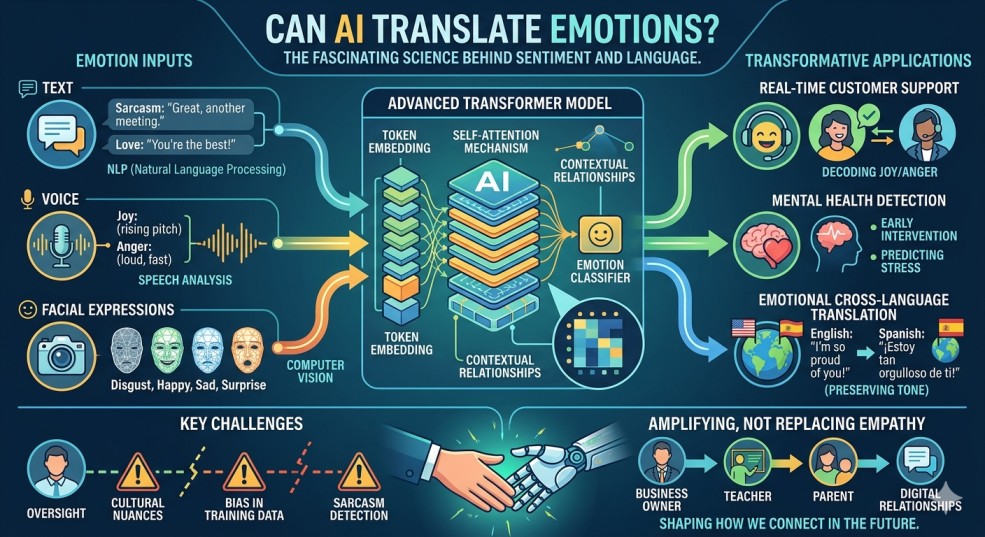
In our hyper-connected world, we express our deepest feelings through texts, reviews, tweets, and messages. But can AI translate emotions — not just words, but the joy, sarcasm, anger, or love hidden between the lines?
The answer is as exciting as it is complex. AI sentiment analysis and emotion AI are transforming how machines understand human feelings across languages and cultures. This isn’t science fiction — it’s happening right now.
What Is AI Emotion Translation?
Sentiment analysis (also called opinion mining) uses natural language processing (NLP) and advanced artificial intelligence to detect the emotional tone in text. Modern systems go far beyond simple positive/negative classification — they identify nuanced emotions like excitement, frustration, empathy, disappointment, and even subtle sarcasm.
Emotion AI, or affective computing, takes this further by trying to “translate” raw text into emotional understanding. It’s like giving machines a form of emotional intelligence that bridges the gap between human hearts and digital language.
The Science Behind the Magic
AI translates emotions through several powerful techniques:
- Lexicon-based methods: Scoring individual words based on emotional value.
- Machine Learning & Deep Learning: Trained on millions of labeled conversations, reviews, and social posts.
- Transformer Models (like BERT and GPT): These understand context, sarcasm, idioms, and cultural nuances exceptionally well.
Today’s large language models can detect subtle emotional shifts and even preserve emotional tone during cross-language translation — turning a heartfelt message in Hindi, Spanish, or Arabic into emotionally equivalent English, for example.
Multimodal emotion AI combines text with voice tone, facial expressions, and even typing patterns for richer “emotional translation.”
Real-World Applications That Will Blow Your Mind
- Customer Experience: Brands instantly know when a customer is angry or delighted from support chats and reviews, allowing faster, more empathetic responses.
- Mental Health Support: Apps detect early signs of anxiety or depression from journaling or voice notes and suggest timely human support.
- Global Communication: AI helps translate not just language but emotion in international business, long-distance relationships, and diplomacy.
- Social Media & Politics: Real-time monitoring of public sentiment during elections or crises.
- Personalized Experiences: Smart assistants that adapt their tone based on your current mood.
The Challenges: Why Perfect Emotional Translation Is Hard
Despite rapid progress, AI translating emotions still faces real limitations:
- Sarcasm, irony, and cultural context remain tricky.
- Emotional expression varies widely across cultures and individuals.
- Bias in training data can lead to misreading emotions from certain demographics or dialects.
- AI doesn’t feel emotions — it simulates understanding based on patterns.
This is why the best systems today combine powerful AI with human oversight.
The Future of Emotionally Intelligent AI
By 2027–2030, we’ll likely see emotion-aware virtual therapists, adaptive learning platforms that sense student frustration in real time, relationship apps that help couples communicate better, and more empathetic customer service bots. The possibilities are endless.
Why This Topic Should Matter to You
Whether you’re a business owner, marketer, teacher, parent, or simply someone who texts their feelings daily — AI emotion translation is going to profoundly shape how we connect in the future.
For business owners and marketers, it means understanding your customers at a deeper level. Imagine knowing exactly how people feel about your product within seconds of reading their review. This leads to better products, stronger loyalty, and smarter marketing campaigns that actually resonate.
Teachers and educators can benefit enormously. Emotion AI can detect when students are confused, frustrated, or disengaged during online classes and adjust teaching methods in real time — creating more inclusive and effective learning experiences.
As a parent, you might use these tools to better understand your teenager’s subtle emotional cues in texts or social media (with privacy in mind, of course), helping you support them through tough times.
Even in everyday life, if you’re in a long-distance relationship or working with international teams, AI that preserves emotional tone can reduce misunderstandings and strengthen bonds across cultures and time zones.
At its core, AI translate emotions is not about replacing human empathy. It’s about amplifying it. Technology becomes a powerful bridge — helping us listen better, respond more thoughtfully, and connect more meaningfully in our increasingly digital world.
This topic matters because it sits at the beautiful intersection of technology, psychology, and human connection. Understanding it empowers you to use these tools wisely rather than fear them.
Conclusion: The Heart Meets the Algorithm
As AI continues to evolve, its ability to translate emotions will only grow more sophisticated. While it may never fully replicate the depth of human feeling, it has the potential to make our digital interactions warmer, more understanding, and genuinely human-centered.
The future belongs to those who embrace this technology thoughtfully — balancing innovation with ethics, privacy, and genuine care.
What do you think? Has an AI tool ever surprised you by perfectly capturing your emotion? Or are you concerned about machines reading our hearts? Share your experiences, stories, or questions in the comments below! If you found this article insightful, please share it with friends, colleagues, or anyone curious about the future of AI and human connection. Let’s keep the conversation going!
Frequently Asked Questions (FAQs)
1. Can AI really understand emotions accurately? AI is getting remarkably good at detecting patterns in language, but it still struggles with sarcasm, cultural nuances, and deeply personal contexts. It’s best used as a supportive tool alongside human judgment.
2. Is emotion AI used in mental health apps? Yes, several apps use sentiment analysis to detect signs of anxiety or depression, but they always recommend professional human help for serious concerns.
3. How accurate is AI in translating emotions across languages? Modern systems are quite effective at preserving emotional tone, especially with transformer models, but results improve significantly when combined with human review.
4. What are the main ethical concerns with emotion AI? Privacy, data consent, potential manipulation, and bias are the biggest concerns. Responsible development and clear regulations will be essential.
5. Will AI replace human emotional intelligence? No. The goal is augmentation — AI helps us become better at understanding and expressing emotions, not replace the beautiful complexity of human empathy.
0 Comments
No comments yet. Be the first to share your thoughts!
Leave a Comment
Your comment will be reviewed before publishing. Fields marked * are required.