
In today’s India, where linguistic diversity is our greatest strength, many forward-thinking companies are realizing one crucial truth: your annual report is only as powerful as the audience that truly understands it.
Imagine a farmer in rural Tamil Nadu, a small investor in Gujarat, or a dedicated employee in Assam — they all deserve to access the same financial story that shareholders in Mumbai or Delhi read effortlessly. This is where annual report translation into regional languages becomes not just a good practice, but a strategic necessity.
Whether you run a listed company, a growing startup, or a public sector undertaking, translating your annual report can dramatically expand trust, improve compliance perception, and strengthen stakeholder relationships. Let’s dive deep into exactly how to do it right.
Why Annual Report Translation Matters More Than Ever
India has many languages, so even though English is widely used in business, most stakeholders feel much more comfortable reading and understanding detailed financial information in their own regional languages.
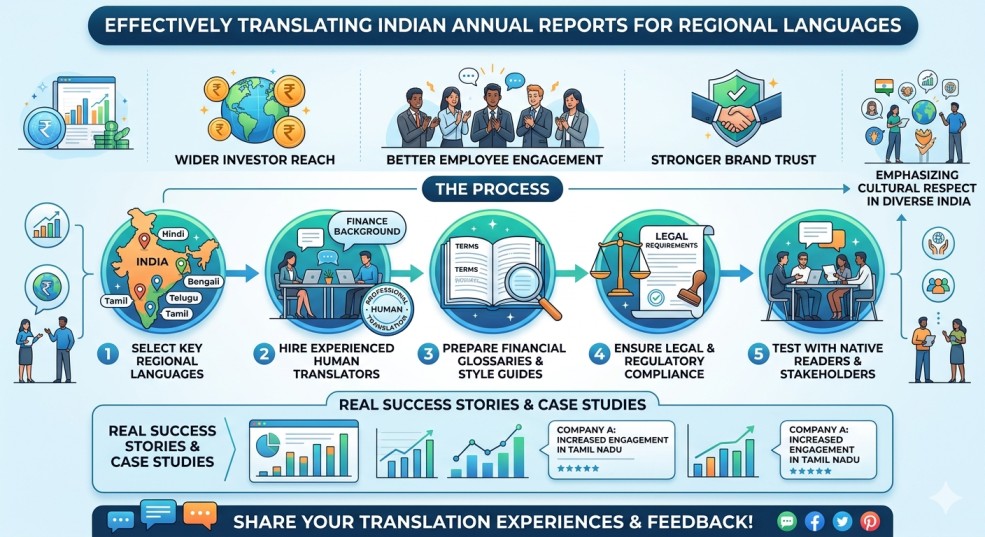
When you translate annual reports into Hindi, Tamil, Telugu, Marathi, Kannada, Bengali, or Gujarati, you achieve powerful outcomes:
- Wider Investor Reach: Retail investors from Tier-2 and Tier-3 cities feel genuinely included.
- Better Regulatory Perception: Demonstrates respect for local governance and inclusive disclosure practices.
- Enhanced Employee Engagement: Workers across different plants and branches can clearly understand company performance.
- Stronger Brand Loyalty: Shows cultural sensitivity in a wonderfully diverse nation.
One mid-sized manufacturing company in Pune shared that after translating their annual report into Marathi and Hindi, their local investor attendance at AGMs increased by nearly 40%. Real impact.
Key Challenges in Financial Report Translation
Translating an annual report isn’t like translating a simple document. It’s a highly specialized task involving:
- Technical Financial Terminology: Precise handling of terms like “EBITDA,” “impairment,” “contingent liabilities,” and “deferred tax assets.”
- Legal and Regulatory Nuances: Maintaining exact meaning to avoid compliance risks under Companies Act, SEBI, and Ind-AS.
- Consistency Across 100+ Pages: Uniform tone, terminology, and formatting throughout the document.
- Cultural Adaptation: Ensuring the message resonates without altering core facts.
Poor translation can lead to misinterpretation, legal issues, or loss of credibility.
Step-by-Step Guide: How to Translate Annual Reports Effectively
Step 1: Define Your Target Languages Strategically Don’t translate into every language at once. Start with high-impact ones based on your operations and shareholder base — Hindi for wide reach, followed by Tamil, Telugu, Kannada, Marathi, Bengali, or Gujarati depending on your key regions.
Step 2: Choose the Right Translation Approach The best results come from professional human translators who specialize in financial content.
- Hire experienced translators with strong backgrounds in finance and banking translation.
- Ensure they are native speakers of the target regional language with proven expertise in handling complex financial documents.
- Always include an independent review process with a second senior translator for thorough quality assurance.
Step 3: Prepare Source Documents Properly
- Use clean, well-formatted English files.
- Create a detailed Glossary of Terms at the beginning to ensure consistency in financial terminology.
- Keep original tables, charts, and graphs intact — translate only the text and captions.
Step 4: Ensure Legal and Design Compliance
- Clearly mention if the translated version is for reference purposes.
- Maintain identical layout, fonts, and visual design.
- Coordinate closely with your company secretary and auditors for listed companies.
Step 5: Test with Your Audience Before final distribution, share sample sections with native speakers from your target regions and gather feedback on clarity and cultural appropriateness.
Best Practices That Separate Good Translations from Great Ones
- Maintain Professional Tone: The Chairman’s message and management discussion should reflect the same confidence and optimism in every language.
- Visual Consistency: Keep design elements professional while ensuring regional readers feel connected.
- Digital-First Format: Create mobile-friendly interactive PDFs, as many regional readers access reports on smartphones.
- Version Control: Clearly date and label all language versions.
Real-World Success Stories
Several leading Indian companies and PSUs have successfully adopted multilingual annual reports. One FMCG company in South India translated their report into Tamil and Malayalam, resulting in improved distributor confidence and more meaningful discussions among factory workers.
Cost and Timeline Considerations
A typical 150-300 page annual report takes 3-6 weeks for professional human translation into 3-4 languages. While the investment is worthwhile, the long-term returns through enhanced trust and stakeholder engagement are significant.
Conclusion: Make Your Story Heard in Every Voice of India
Translating annual reports into regional languages is more than a technical exercise — it is an act of respect. It tells your company’s success story in the language people think, feel, and make decisions in.
In a country as diverse as ours, companies that communicate inclusively will always enjoy stronger connections and lasting advantages.
Ready to make your annual report truly pan-Indian?
Start by reviewing your last report. Which regional languages would create the biggest impact for your stakeholders?
Have you faced any challenges while translating your company’s annual reports? Have you tried regional language versions for your stakeholders?
Share your experiences, success stories, or questions in the comments below!
If you found this guide useful, please share it with your fellow professionals, company secretaries, and business leaders. The more companies embrace this practice, the more inclusive corporate India becomes.
Let’s celebrate linguistic diversity in Indian business together!
0 Comments
No comments yet. Be the first to share your thoughts!
Leave a Comment
Your comment will be reviewed before publishing. Fields marked * are required.