
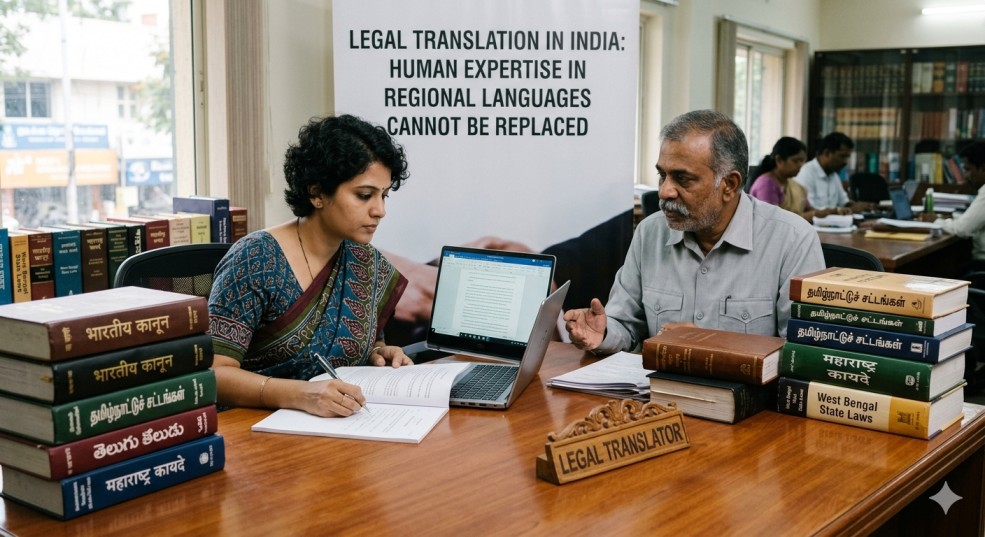
Imagine a widowed mother in a small village in Uttar Pradesh receiving a court judgment in English that she cannot read. Her entire inheritance and future depend on an accurate translation into Hindi or Bhojpuri. Or envision a tech startup in Bengaluru signing a multimillion-rupee contract where subtle differences in Kannada legal terminology could void the agreement. These scenarios play out daily across India, underscoring why legal translation in India is far more than a linguistic exercise—it’s a cornerstone of justice, business, and equality.
As someone who has partnered with lawyers, government bodies, and businesses across states, I’ve seen the profound human element required in regional language translation. Machines offer speed, but they lack the soul, context, and accountability that certified professionals bring. In this extensive guide—drawing from real experiences and industry realities—we’ll explore the linguistic diversity of India, the high stakes involved, why human expertise remains unmatched, practical challenges, success stories, and actionable tips. By the end, you’ll understand why investing in skilled translators isn’t an expense but a necessity for fair outcomes.
India’s Linguistic Diversity: A Legal Minefield
India boasts 22 constitutionally recognized languages and over 1,600 dialects, with Hindi, Tamil, Bengali, Telugu, Marathi, and others serving as lifelines for millions. While English dominates higher judiciary, the push for regional languages in lower courts and administration is growing. The Constitution and Official Languages Act support this multilingualism, yet it creates a massive demand for accurate legal translation in India.
Central laws are often in English, but state-specific personal laws (Hindu, Muslim, Christian), local judgments, FIRs, affidavits, property deeds, and witness statements frequently appear in regional tongues. Only about 10% of Indians are fully comfortable with English for complex reading, making quality translation essential for access to justice.
Human translators excel because they understand not just vocabulary but the socio-cultural fabric. A phrase in Punjabi land records might reference customary practices rooted in community history that no algorithm can fully capture.
The Critical Role of Certified Legal Translators
Certified legal translators are specialists with deep knowledge of both legal systems and multiple languages. Many hold degrees in law combined with linguistics, certifications from recognized bodies, or experience working with High Courts and the Supreme Court.
Their work ensures:
- Fidelity to Intent: Preserving legal meaning across systems.
- Cultural Adaptation: Conveying nuances without distortion.
- Compliance: Producing court-admissible documents with proper notarization or affidavits of accuracy.
Unlike general translators, they navigate colonial legacies (English-based laws) alongside indigenous concepts, such as those in ancient texts or regional customs still influencing modern judgments.
Human vs Machine Legal Translation: Why Machines Can’t Replace Humans
The debate on human vs machine legal translation is settled in high-stakes fields: machines assist, but humans lead. AI tools like Google Translate or advanced neural systems handle simple texts but falter with legal precision. Legal language is dense with archaic terms, conditionals, and jurisdiction-specific jargon. A mistranslation of “specific performance” in a contract or a witness statement’s emotional weight can alter outcomes dramatically.
In India, challenges amplify due to script variations (Devanagari vs. Dravidian scripts), dialectal differences, and lack of standardized digital corpora for many languages. Handwritten documents in regional languages—common in many states—pose additional readability issues that humans resolve through context and expertise.
Machines lack empathy for sensitive family matters, cannot consult lawyers in real-time for clarification, and risk confidentiality breaches. Human experts use CAT tools for consistency while applying judgment, back-translation, and peer review—ensuring zero tolerance for errors in Indian court document translation.
Major Challenges in Regional Language Translation
India’s diversity creates unique hurdles:
- Script and Dialect Variations: Translating between 22+ languages involves different scripts, grammar structures, and regional idioms. A term in Gujarati might carry business connotations absent in standard Hindi.
- Legal Pluralism: Personal laws vary by religion and state. Translators must align concepts like succession rights across frameworks.
- Handwritten and Archaic Documents: Many lower court records are handwritten, making interpretation time-intensive and error-prone without human insight.
- Volume and Urgency: During elections, disasters, or major litigations, demand surges. Certified teams deliver under pressure without compromising quality.
- Confidentiality and Ethics: Handling sensitive data in matrimonial, criminal, or corporate cases requires ironclad professionalism.
- Technological Gaps: Limited high-quality training data for Indian languages hampers pure AI performance.
These challenges explain why multilingual legal services India rely heavily on human professionals.
Real-Life Stories That Highlight the Stakes
Consider a land dispute in rural Tamil Nadu. A machine-translated document missed nuances in local customary law, nearly costing a family their ancestral property. A certified translator, familiar with regional practices, clarified intent and secured a favorable judgment.
In another case, a Bengaluru IT firm’s English-Kannada contract translation by non-specialists led to disputes over liability clauses. Expert intervention resolved ambiguities rooted in cultural business expectations, saving the partnership.
Immigration and asylum cases involving Northeast languages or Urdu often hinge on precise cultural context in statements—areas where human empathy and knowledge prevent life-altering errors.
These aren’t isolated incidents. Poor translation exacerbates inequalities, delays justice, and hampers economic growth in a nation pushing “Ease of Doing Business.”
Best Practices for Effective Legal Translation in India
To ensure success:
- Engage certified legal translators with domain expertise in your specific area (family, criminal, commercial, IP).
- Supply full context: purpose, target jurisdiction, glossaries, and reference materials.
- Demand a rigorous process: initial translation, independent editing, proofreading, and back-translation verification.
- Plan for certification: notarization, apostilles for international use, or compliance with court guidelines.
- Use secure platforms to protect confidentiality.
- For businesses, integrate translation early in cross-state or international expansions.
- Combine technology wisely—AI for drafts, humans for final validation.
Government and private sectors should invest in training more specialists to meet rising demand as regional languages gain prominence in administration.
The Human Element: Beyond Words to Justice
Legal translators in India often work late nights ensuring a Dalit farmer understands his rights or a woman in Kerala navigates inheritance laws in Malayalam. This emotional and intellectual labor carries immense responsibility. They bridge not just languages but worlds—urban-rural, English-regional, modern-traditional.
Their expertise upholds constitutional values of equality and access to justice. In a country where linguistic barriers can silence voices, skilled translators amplify them.
Future Outlook: Hybrid Approaches with Human at the Core
AI will evolve, aiding high-volume tasks and terminology management. Initiatives to digitize Indian legal corpora could improve machine support. Yet, for court-admissible work, regulatory frameworks will likely continue mandating human oversight. Hybrid models—AI draft + expert refinement—represent the future, but the irreplaceable core remains human judgment, cultural intelligence, and ethical accountability.
As India’s economy integrates globally and internally, demand for legal translationd mother in a small village in Uttar Pradesh receiving a court judgment in English that she cannot read. Her entire inheritance and future depend on an accurate translation into Hindi or Bhojpuri. Or envision a tech startup in Bengaluru signing a multimillion-rupee contract where subtle differences in Kannada legal terminology could void the agreement. These scenarios play out daily across India, underscoring why legal translation in India is far more than a linguistic exercise—it’s a cornerstone of justice, business, and equality.
As someone who has partnered with lawyers, government bodies, and businesses across states, I’ve seen the profound human element required in regional language translation. Machines offer speed, but they lack the soul, context, and accountability that certified professionals bring. In this extensive guide—drawing from real experiences and industry realities—we’ll explore the linguistic diversity of India, the high stakes involved, why human expertise remains unmatched, practical challenges, success stories, and actionable tips. By the end, you’ll understand why investing in skilled translators isn’t an expense but a necessity for fair outcomes.
India’s Linguistic Diversity: A Legal Minefield
India boasts 22 constitutionally recognized languages and over 1,600 dialects, with Hindi, Tamil, Bengali, Telugu, Marathi, and others serving as lifelines for millions. While English dominates higher judiciary, the push for regional languages in lower courts and administration is growing. The Constitution and Official Languages Act support this multilingualism, yet it creates a massive demand for accurate legal translation in India.
Central laws are often in English, but state-specific personal laws (Hindu, Muslim, Christian), local judgments, FIRs, affidavits, property deeds, and witness statements frequently appear in regional tongues. Only about 10% of Indians are fully comfortable with English for complex reading, making quality translation essential for access to justice.
Human translators excel because they understand not just vocabulary but the socio-cultural fabric. A phrase in Punjabi land records might reference customary practices rooted in community history that no algorithm can fully capture.
The Critical Role of Certified Legal Translators
Certified legal translators are specialists with deep knowledge of both legal systems and multiple languages. Many hold degrees in law combined with linguistics, certifications from recognized bodies, or experience working with High Courts and the Supreme Court.
Their work ensures:
Unlike general translators, they navigate colonial legacies (English-based laws) alongside indigenous concepts, such as those in ancient texts or regional customs still influencing modern judgments.
Human vs Machine Legal Translation: Why Machines Can’t Replace Humans
The debate on human vs machine legal translation is settled in high-stakes fields: machines assist, but humans lead. AI tools like Google Translate or advanced neural systems handle simple texts but falter with legal precision. Legal language is dense with archaic terms, conditionals, and jurisdiction-specific jargon. A mistranslation of “specific performance” in a contract or a witness statement’s emotional weight can alter outcomes dramatically.
In India, challenges amplify due to script variations (Devanagari vs. Dravidian scripts), dialectal differences, and lack of standardized digital corpora for many languages. Handwritten documents in regional languages—common in many states—pose additional readability issues that humans resolve through context and expertise.
Machines lack empathy for sensitive family matters, cannot consult lawyers in real-time for clarification, and risk confidentiality breaches. Human experts use CAT tools for consistency while applying judgment, back-translation, and peer review—ensuring zero tolerance for errors in Indian court document translation.
Major Challenges in Regional Language Translation
India’s diversity creates unique hurdles:
- Script and Dialect Variations: Translating between 22+ languages involves different scripts, grammar structures, and regional idioms. A term in Gujarati might carry business connotations absent in standard Hindi.
- Legal Pluralism: Personal laws vary by religion and state. Translators must align concepts like succession rights across frameworks.
- Handwritten and Archaic Documents: Many lower court records are handwritten, making interpretation time-intensive and error-prone without human insight.
- Volume and Urgency: During elections, disasters, or major litigations, demand surges. Certified teams deliver under pressure without compromising quality.
- Confidentiality and Ethics: Handling sensitive data in matrimonial, criminal, or corporate cases requires ironclad professionalism.
- Technological Gaps: Limited high-quality training data for Indian languages hampers pure AI performance.
These challenges explain why multilingual legal services India rely heavily on human professionals.
Real-Life Stories That Highlight the Stakes
Consider a land dispute in rural Tamil Nadu. A machine-translated document missed nuances in local customary law, nearly costing a family their ancestral property. A certified translator, familiar with regional practices, clarified intent and secured a favorable judgment.
In another case, a Bengaluru IT firm’s English-Kannada contract translation by non-specialists led to disputes over liability clauses. Expert intervention resolved ambiguities rooted in cultural business expectations, saving the partnership.
Immigration and asylum cases involving Northeast languages or Urdu often hinge on precise cultural context in statements—areas where human empathy and knowledge prevent life-altering errors.
These aren’t isolated incidents. Poor translation exacerbates inequalities, delays justice, and hampers economic growth in a nation pushing “Ease of Doing Business.”
Best Practices for Effective Legal Translation in India
To ensure success:
- Engage certified legal translators with domain expertise in your specific area (family, criminal, commercial, IP).
- Supply full context: purpose, target jurisdiction, glossaries, and reference materials.
- Demand a rigorous process: initial translation, independent editing, proofreading, and back-translation verification.
- Plan for certification: notarization, apostilles for international use, or compliance with court guidelines.
- Use secure platforms to protect confidentiality.
- For businesses, integrate translation early in cross-state or international expansions.
- Combine technology wisely—AI for drafts, humans for final validation.
Government and private sectors should invest in training more specialists to meet rising demand as regional languages gain prominence in administration.
The Human Element: Beyond Words to Justice
Legal translators in India often work late nights ensuring a Dalit farmer understands his rights or a woman in Kerala navigates inheritance laws in Malayalam. This emotional and intellectual labor carries immense responsibility. They bridge not just languages but worlds—urban-rural, English-regional, modern-traditional.
Their expertise upholds constitutional values of equality and access to justice. In a country where linguistic barriers can silence voices, skilled translators amplify them.
Future Outlook: Hybrid Approaches with Human at the Core
AI will evolve, aiding high-volume tasks and terminology management. Initiatives to digitize Indian legal corpora could improve machine support. Yet, for court-admissible work, regulatory frameworks will likely continue mandating human oversight. Hybrid models—AI draft + expert refinement—represent the future, but the irreplaceable core remains human judgment, cultural intelligence, and ethical accountability.
As India’s economy integrates globally and internally, demand for legal translationwill surge. Policymakers, businesses, and citizens must prioritize quality human services.
Conclusion: Honoring the Unsung Heroes
Legal translation in India
is a profound act of service. Human expertise in regional languages ensures laws are not just translated but truly understood and applied fairly. It cannot be replaced because language is living, contextual, and tied to human experience.
Whether you’re a legal practitioner, entrepreneur, student, or citizen, appreciating this reality leads to wiser decisions. Let’s celebrate and support these professionals who make multilingual India function equitably.
Join the Conversation! Have you encountered challenges with legal documents in regional languages? Was a translation a game-changer (or nightmare) in your experience? Share your stories, insights, or questions in the comments below. What surprised you most about the human role in legal translation?
If this article resonated with you—highlighting the irreplaceable value of expertise in regional language translation —please share it with lawyers, businesses, policymakers, friends across states, or on social media. Your share could educate others and contribute to better practices. Let’s spread awareness and advocate for quality multilingual legal services!
Related Articles

0 Comments
No comments yet. Be the first to share your thoughts!
Leave a Comment
Your comment will be reviewed before publishing. Fields marked * are required.