When Words Carry More Than Meaning
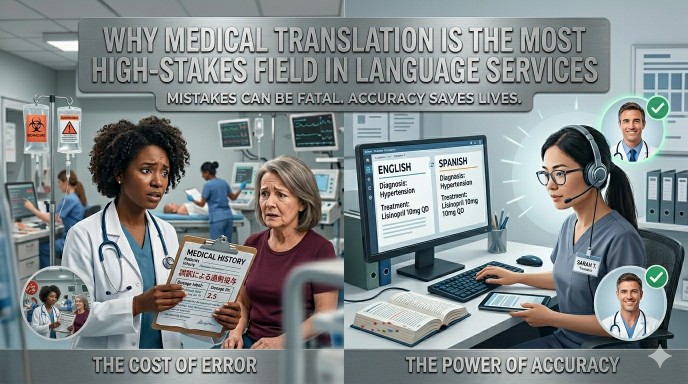
Every translation carries responsibility. But in the world of medical translation, that responsibility reaches a level that few other fields can match. A marketing translator who misses a nuance might produce a campaign that falls flat. A legal translator who mistranslates a clause could trigger a contract dispute. But a medical translator who gets a single term wrong — one dosage instruction, one contraindication, one critical warning — can set off a chain of consequences that no correction, no apology, and no revision can undo.
This is not hyperbole. It is the daily reality that professional medical translators live with, and it is exactly why medical translation stands in a league of its own within the broader language services industry.
The Sheer Scope of What “Medical Translation” Actually Means
Most people outside the translation industry assume medical translation simply means converting a prescription leaflet from one language to another. In reality, it is a vast, multi-layered discipline that spans an enormous range of document types and contexts.
Medical translators work across clinical trial protocols and regulatory submission dossiers, informed consent forms and patient information leaflets, case report forms and clinical study reports, pharmaceutical product labeling and package inserts, medical device manuals and instructions for use, scientific journal articles and research papers, discharge summaries and patient records, and public health communication materials.
Each of these document types carries its own set of terminology, formatting conventions, audience expectations, and regulatory requirements. A translator who excels at rendering scientific research papers may not be the right fit for a patient-facing informed consent form, where plain language and cultural accessibility matter just as much as terminological precision. The scope is wide, and the stakes shift with every document type.
The Language of Medicine: A World unto Itself
Medical language is not simply formal or technical language. It is a highly specialized system of terminology built on Latin and Greek roots, international nomenclature, standardized coding systems, and constantly evolving scientific vocabulary.
Consider the difference between the words “hypertension” and “high blood pressure.” They describe the same condition, but their usage contexts differ significantly — one belongs to clinical documentation, the other to patient-facing communication. A skilled medical translator must know not only what a term means, but where it belongs, who will read it, and what regulatory standards govern its use in the target language.
Then there is the challenge of false cognates — words that look or sound similar across languages but carry entirely different meanings. In many European languages, medical terms that appear close to their English equivalents can diverge sharply in clinical meaning. In less widely translated languages, the problem is compounded by the absence of standardized medical glossaries, forcing translators to make carefully considered terminological decisions rather than relying on established equivalents.
Medical translation also demands consistency at a level that goes beyond most other translation domains. The same term must be rendered the same way across an entire document set — across hundreds of pages of a clinical trial dossier, across multiple versions of a regulatory submission, across years of an ongoing pharmaceutical project. Inconsistency is not merely a stylistic flaw; it can constitute a regulatory failure.
Regulatory Pressure: Translation as a Legal Obligation
One of the defining features of medical translation that sets it apart from almost every other area of language services is its embeddedness in regulatory frameworks. This is not translation in service of communication alone. It is translation as a legal obligation.
Regulatory bodies such as the European Medicines Agency (EMA), the U.S. Food and Drug Administration (FDA), the World Health Organization (WHO), and national health authorities around the world impose strict requirements on how medical documents must be translated, reviewed, and certified. Pharmaceutical companies seeking approval for a new drug in multiple markets must submit accurate, verified translations of extensive dossiers — and any error in those translations can delay approval, trigger a request for revision, or, in serious cases, lead to regulatory rejection.
The International Conference on Harmonisation (ICH) guidelines, which govern the development and registration of pharmaceutical products across multiple regions, include specific provisions related to documentation and translation. Compliance is not optional. For a medical translator, working within this landscape means understanding that their output will be scrutinized not just by readers, but by regulators.
Informed Consent: Translation at Its Most Human
Perhaps the most emotionally charged arena of medical translation is the informed consent form. Before a person can participate in a clinical trial, they must be given clear, comprehensible information in their own language — about the nature of the study, the procedures involved, the risks and potential benefits, and their right to withdraw at any time.
“Participation by individuals capable of giving informed consent... must be voluntary.” — Source: World Medical Association, Declaration of Helsinki
For that voluntariness to be genuine, the language must be genuinely understood. A translation that is technically accurate but linguistically inaccessible — overly complex, culturally tone-deaf, or riddled with jargon — undermines the very purpose of informed consent. The translator's task here is to render not just words, but comprehension itself. That is a responsibility that few other translation tasks come close to placing on a professional's shoulders.
The Human Dimension: Who Reads These Documents?
It is easy, in discussing regulatory frameworks and terminological precision, to lose sight of the human beings at the end of the translation chain. But medical translation is ultimately about people — patients, caregivers, clinical trial participants, and healthcare communities — who depend on translated content to make meaningful decisions.
A patient reading a translated medication guide in a language they understand relies on that translation being accurate, clear, and complete. A caregiver following translated discharge instructions relies on every detail being correctly conveyed. A clinical trial participant reading a consent form in their native language relies on that document telling them the truth — the full truth — about what they are agreeing to.
This human dimension is what gives medical translation its moral weight. Every translated document is, in a very real sense, a bridge between knowledge and a person who needs it. When that bridge is well-built, communication flows. When it is poorly built, the consequences can be profound and irreversible.
What Makes a Medical Translator Truly Qualified?
Given all of this, it becomes clear why medical translation is not a field for generalists. The bar for entry is high, and rightly so.
A qualified medical translator typically holds a degree or formal training in translation combined with specialist knowledge in a medical, scientific, or pharmaceutical field. Many have academic or professional backgrounds in life sciences, pharmacy, nursing, or biomedical research — giving them the subject-matter depth to understand what they are translating, not just the language they are translating into.
Beyond subject knowledge, professional medical translators work within structured quality frameworks. Translation Memory tools ensure terminological consistency across large document sets. Subject-matter expert reviewers check translations for clinical accuracy. Back-translation — the process of translating a document back into the source language to verify fidelity — is commonly used for critical patient-facing documents.
Professional bodies such as the American Translators Association (ATA), the Chartered Institute of Linguists (CIOL), and the International Medical Interpreters Association (IMIA) provide certification pathways, ethical guidelines, and continuing professional development frameworks that help maintain standards in this demanding field.
The Cost of Getting It Wrong
The translation industry as a whole has its share of cautionary tales, but few domains generate examples as stark as medical translation. Documented cases from translation research and regulatory history include instances where ambiguous pharmaceutical instructions led to incorrect usage, where mistranslated clinical trial documents caused costly regulatory setbacks, and where poorly localized patient-facing materials left trial participants without a genuine understanding of what they had agreed to.
“Language quality in global clinical trials directly affects patient safety and data integrity.” — Source: Common Sense Advisory, Language Services Market Research
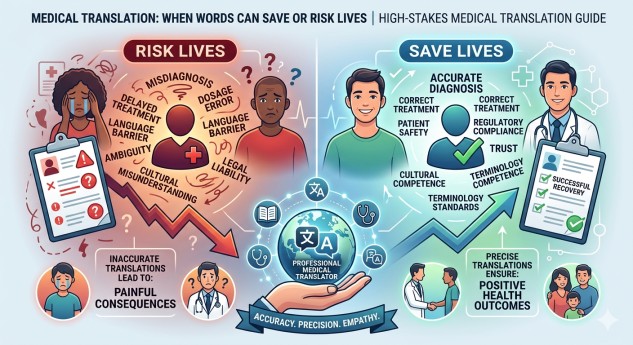
The cost of a medical translation error is not measured only in financial terms. It is measured in delayed treatments, compromised research, regulatory setbacks, and in the erosion of trust between healthcare systems and the communities they serve.
Why This Field Deserves Its Reputation
Medical translation occupies a unique position in the world of language services because it sits at the intersection of science, law, ethics, and human communication. No other field demands such a precise alignment of linguistic skill, subject-matter expertise, regulatory awareness, and cultural sensitivity — all at once, in every document.
It is a field where the translator's name may never appear on the finished product, but their fingerprints are on every word. It is a field where excellence is invisible and errors are unforgettable.
That is what makes it the most high-stakes field in language services. Not drama, not hyperbole — just the quiet, immense weight of words that matter.
Have thoughts on medical translation standards or experiences from the language services industry? Share them in the comments below.
💬 2 Comments
Great content. Learned a lot of translation formula
Great content. Learned a lot of translation formula
Thanks for your valuable comments.
✍️ Leave a Comment
Your comment will be reviewed before publishing. Fields marked * are required.